
Education
What Determines the Value of Your Gold
Gold value comes down to two layers: the live market price for pure gold, and the item-specific factors that determine how much of that value applies to your piece.
Published · Gold King, Houston TX
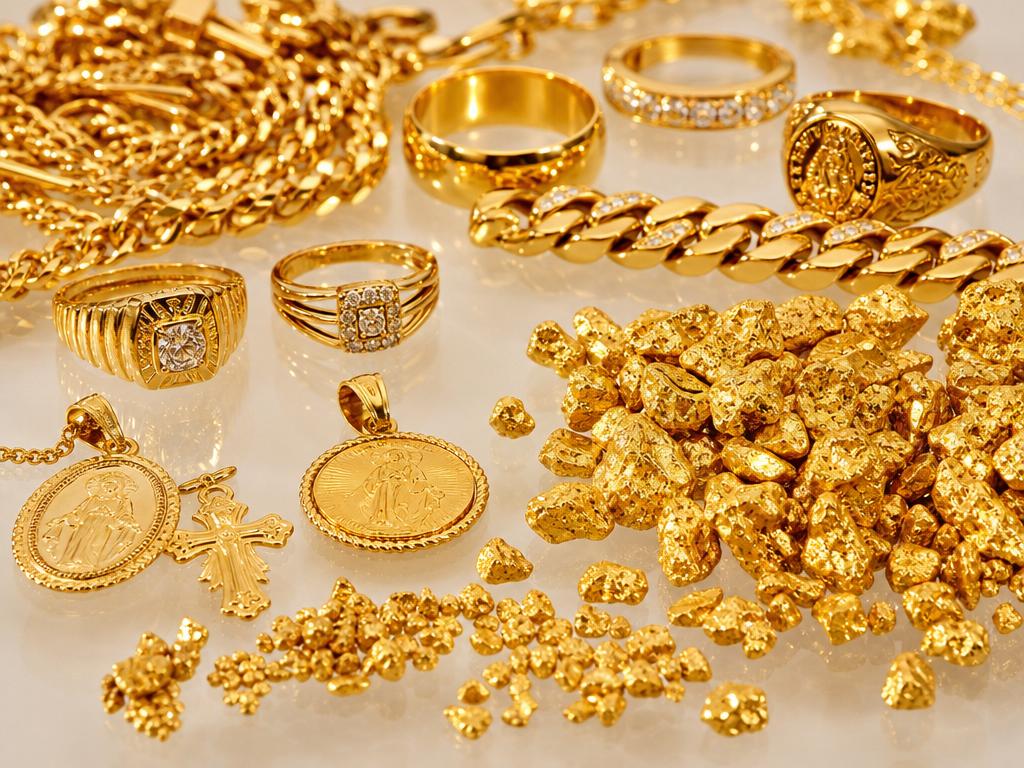
Layer one: the live spot price
Every gold transaction starts with the spot price — the real-time global trading price for one troy ounce of pure (24K) gold. Spot price moves constantly during market hours based on macroeconomic factors like inflation expectations, currency strength, central bank buying, and investor demand for safe-haven assets during periods of uncertainty. It is the same number worldwide at any given moment, and it's the foundation every gold buyer works from.
Because spot price shifts by the minute, the value of your gold isn't a fixed number you can look up once and rely on later — it's tied to whatever the market is doing at the moment you walk in the door. A reputable buyer will check the current spot price with you and show you how it factors into your offer, rather than quoting a stale number from days earlier.
Layer two: karat purity
Spot price applies to pure, 24K gold, but almost no jewelry is made from 24K gold because pure gold is too soft for everyday wear. Jewelry is alloyed with metals like copper, silver and zinc to add strength and change color, which is why karat markings matter so much: 10K gold is 41.7% pure gold, 14K is 58.3%, 18K is 75%, and so on. The karat percentage is multiplied against the spot price to determine the value of the actual gold content in your item.
This is also why two rings of identical size and weight can be worth very different amounts — an 18K ring contains substantially more actual gold than a 10K ring of the same weight, even though they might look nearly identical to the eye.
Layer three: weight
Weight, measured precisely in grams on a calibrated scale, is the third core input. Gold buyers weigh only the gold portion of an item — stones, non-gold findings, and heavy clasps are excluded from the gold weight calculation and, if valuable, may be evaluated and priced separately.
This is why a piece that looks large and impressive isn't automatically worth more than a small, dense one. A hollow, lightweight bangle can weigh less than a small, solid ring, and weight — not visual size — is what goes into the math.
- Spot price: the live global price for pure gold
- Karat: the percentage of pure gold in the alloy
- Weight: measured in grams, gold content only
- Formula: spot price per gram x karat percentage x grams = gold content value
When items are worth more than their gold content
Not every item is priced purely on melt value. Signed designer pieces, brand-name jewelry in excellent wearable condition, investment-grade coins and bullion with recognized mint marks, and luxury watches with gold cases can carry a collector or resale premium above their raw gold content. In these cases, the craftsmanship, brand recognition, condition and market demand for the specific piece matter as much as or more than the melt value.
The difference matters practically: a scrap gold chain is priced almost entirely on melt value, while an intact designer bracelet or a well-preserved gold coin might be evaluated on both its metal content and its collector value, whichever is higher. A good buyer will tell you which basis they're using and why.
Condition, purity confirmation, and getting an accurate number
Condition plays a smaller role for straightforward scrap gold — a broken or tangled chain is worth the same per gram as an intact one — but it matters more for pieces being considered for their resale or collector value rather than melt value. Damage that would need costly repair to make a piece sellable as jewelry can push an item toward being valued at melt price instead.
The only way to get an accurate number is to have your item professionally tested and weighed, since karat markings can be missing, worn, or occasionally inaccurate, and eyeballing weight is never reliable. We test and weigh every item free of charge, in front of you, at 6809 Southwest Freeway, Houston, TX 77074. Stop in during store hours (Monday–Thursday 9:30 AM–7:00 PM, Friday–Saturday 9:30 AM–8:00 PM, Sunday 12:00–7:00 PM) or call 713-997-0875 to ask questions before you come in.
Ready to sell? Gold King buys these items in Houston every day — sell gold in Houston, cash for gold in Houston, sell bullion in Houston and sell coins in Houston. Every appraisal is free, and payment is cash on the spot.
Questions about your item, or want a free in-person evaluation at 6809 Southwest Freeway, Houston?
Call Gold King at 713-997-0875Keep reading
These Gold King guides cover the same subject from different angles:
- EducationHow Gold Buyers Test Gold (What to Watch For)See exactly how a reputable Houston gold buyer verifies karat and purity, from hallmarks and magnets to XRF and acid testing.
- PricingHow Much Is My Gold Worth? (Houston Guide)Work out what your gold jewelry is worth before you sell: karat, weight, live spot price and the simple math Houston gold buyers use.
- PricingGold Melt Value Explained: How It's CalculatedHow gold melt value is calculated, why it's the floor price for scrap gold, and when a piece is worth more than its melt value.
- EducationPawn Shop vs. Gold Buyer: Which Pays More?Compare pawn shop loans against selling to a dedicated gold buyer in Houston — how payouts, speed and ownership differ.
- EducationCommon Mistakes People Make Selling GoldAvoid the most common mistakes gold sellers make in Houston, from skipping comparisons to misunderstanding karat and cleaning jewelry.
- EducationWhat to Bring to Sell Gold: ID, Papers & ChecklistYes, you need a photo ID. Here is the full checklist of what to bring when you sell gold, jewelry, coins or watches — and what you can leave at home.
Selling from outside central Houston? We buy from Houston, Memorial and West University Place customers every week.
Start at the Gold King homepage for everything we buy, or contact our Houston store for a free appraisal and a same-day cash offer.
Questions about this guide
- Does the color of my gold affect its value?
- Color comes from the alloy mix (rose gold has more copper, white gold often has nickel or palladium) rather than purity, so color alone doesn't determine value — karat and weight do.
- Why did my offer change from what I expected online?
- Online gold value estimates are usually based on generic assumptions about karat and weight. An in-person test and weigh-in gives the actual figures, and spot price may have also moved since you checked.
- Is 24K gold always worth the most?
- Gram for gram, yes, 24K gold has the highest gold content. But a well-made 14K or 18K designer piece can sometimes be worth more overall due to craftsmanship and resale demand.
- Do gemstones in my gold jewelry add to the gold value?
- No, stones are evaluated separately from the gold itself. A ring with a diamond is priced as gold weight plus a separate stone evaluation, not blended together.
- How often does the spot price change?
- Gold spot price moves continuously throughout market trading hours, which is why we check the current price at the time of your visit rather than relying on a number from an earlier day.